
Building knowledge graphs is a pain in the @ss.
So we automated the whole thing.
Arango automates the work that stalls knowledge graph projects. Your team goes from fragmented data to production without the months of manual work in between.
Let’s be honest about what’s actually happening.
Your “knowledge graph initiative” has been in progress for how long now? Three months? Six? And you’re still debugging the ingestion pipeline. Here’s what’s killing your project:
You’re building the graph manually
Your team is hand-modeling ontologies like it’s 2014. Then the data changes, the schema breaks, and everyone pretends the last two sprints didn’t happen.
Your RAG pipeline is a science experiment
Chunk size 512 or 1024? Overlap 20% or 50%? Which embedding model this week? You’re not engineering. You’re guessing. And every new data source resets the whole experiment.
Vector search is lying to you
It returns the nearest match, not the right one. Your AI sounds confident. Your AI is wrong. And your stakeholders are starting to notice.
We didn’t just identify the problem.
We automated the solution.
AutoGraph
Context that builds itself
You shouldn’t need a graph PhD to ship a knowledge graph.
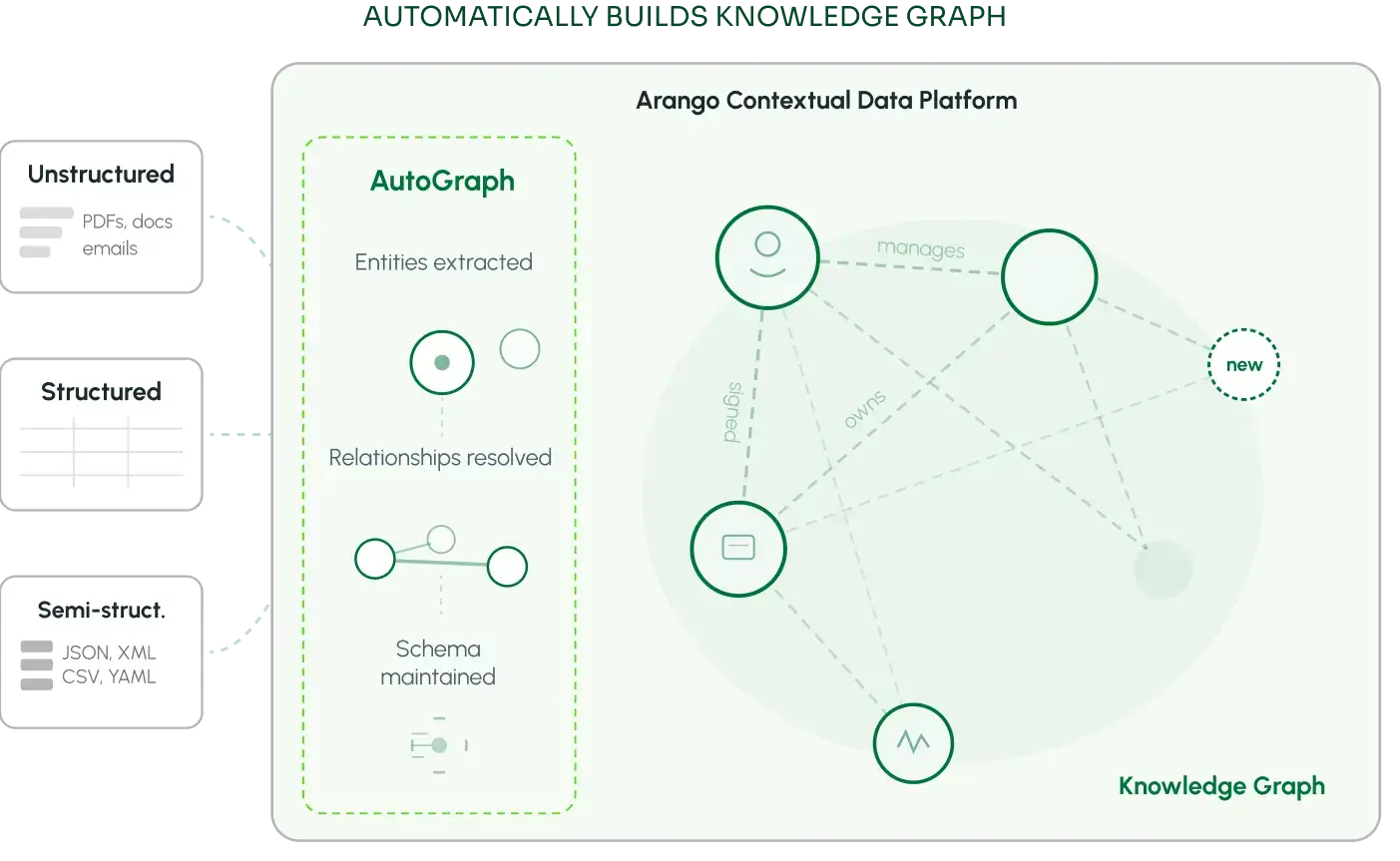
- Automatic graph construction. AutoGraph ingests your data, identifies entities and relationships, and builds a connected knowledge graph. No one on your team needs to know what an ontology is.
- AutoGraph picks the right structure. Determines the optimal graph topology for your data so retrieval is accurate from the start. Not after three rounds of tuning.
- AutoGraph stays current without you. New data flows in, the graph updates. No rebuild cycles. No “hey can someone re-run the pipeline” Slack messages.
- No graph expertise required. No brittle hand-built schemas. No specialized hires. Production-grade knowledge graphs your existing team can actually ship.
AutoRAG
Ingestion built for intelligence
Your retrieval is only as good as your ingestion. What if your ingestion is terrible?
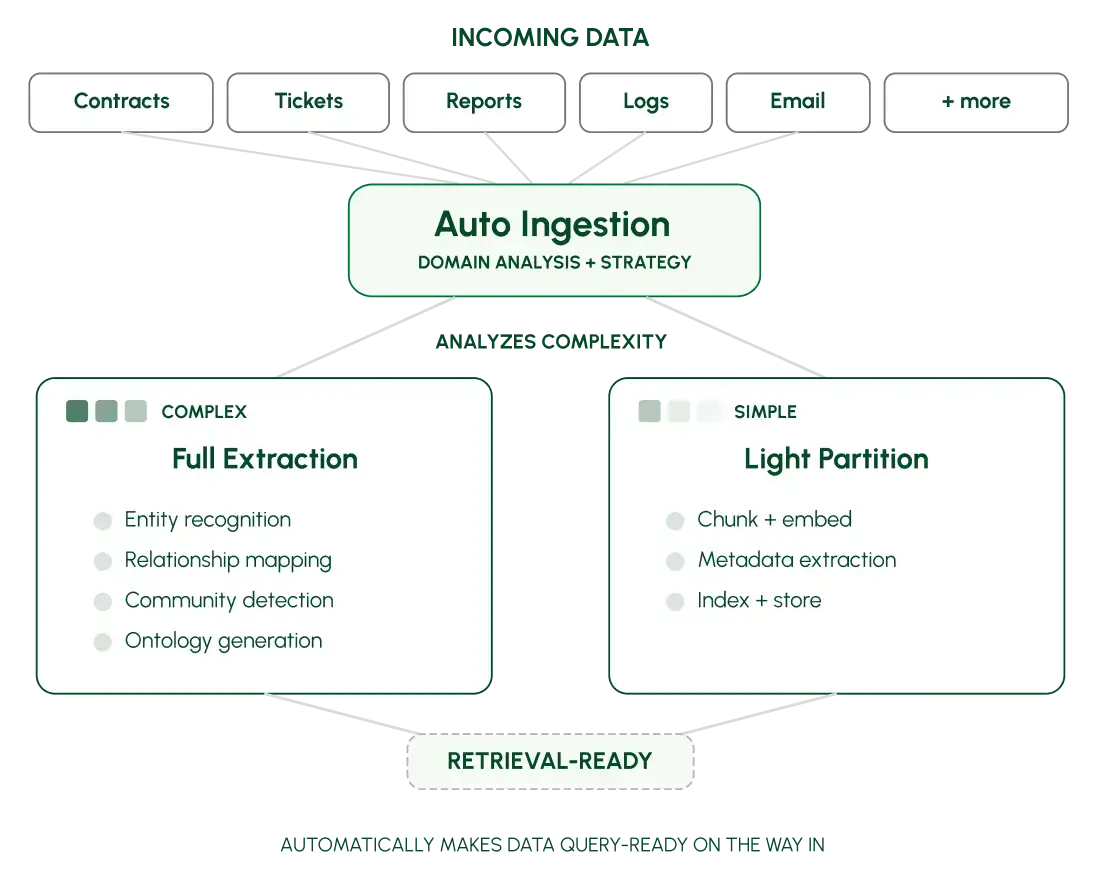
- AutoRAG figures out the ingestion strategy. Determines the optimal processing depth for each data domain. Full entity extraction where it matters. Lighter partitioning where it doesn’t. You don’t configure this.
- AutoRAG makes data retrieval-ready before anyone asks a question. Your knowledge graph is structured for accurate retrieval the moment data lands. Not after your team spends a sprint tuning parameters.
- AutoRAG kills the RAG pipeline busywork. No chunk-size experiments. No embedding model roulette. No “let’s try a different overlap ratio” standups.
- AutoRAG decides quality at ingestion. This is the part most platforms get wrong. They store your data and hope retrieval sorts it out. It doesn’t. AutoRAG makes your data query-ready on the way in.
Deep Search
Retrieval that thinks before it answers
Cosine similarity is not comprehension. Your AI needs to actually understand the question.
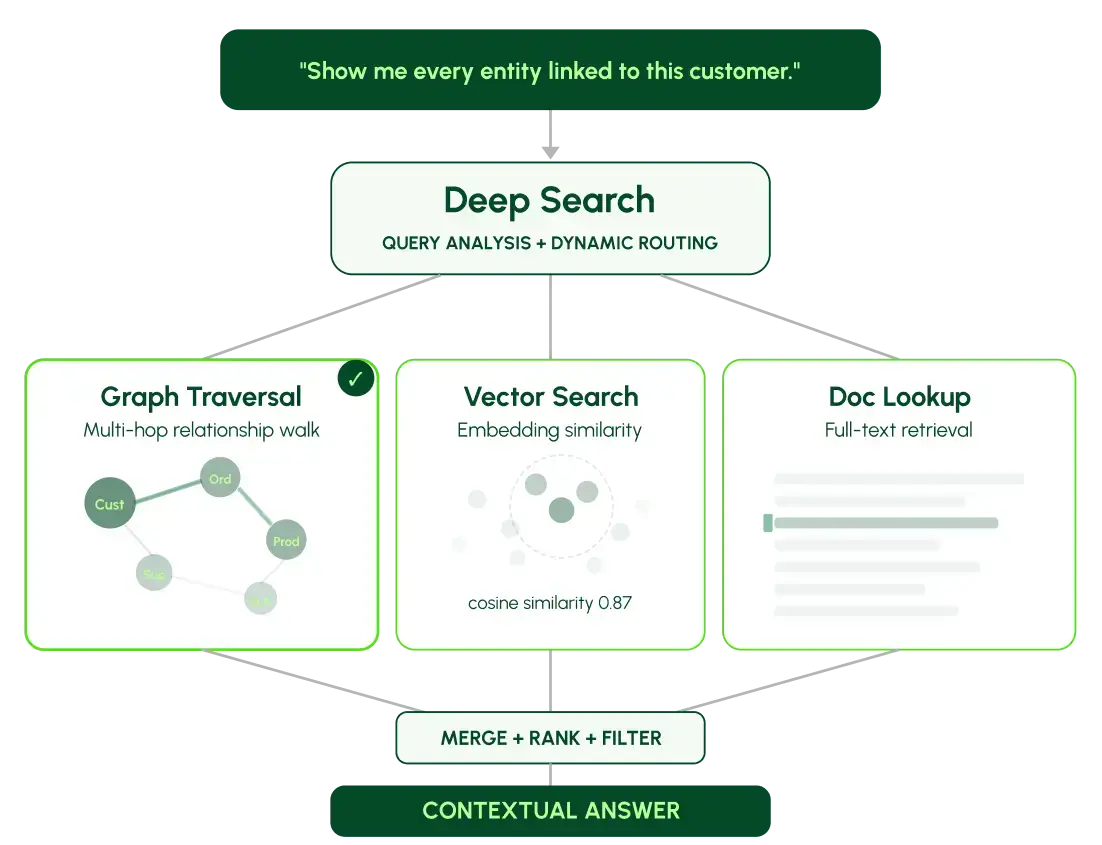
- Deep Search scans for relevance, not similarity. Scans topics across your knowledge graph to find what’s actually relevant to the query. Not what’s closest in embedding space. There’s a difference.
- Deep Search picks the right retriever. Graph traversal, vector similarity, or document lookup. Selects the right method per query. Your team doesn’t touch a config file.
- Deep Search works across every source without duct tape. Internal data, external sources, structured and unstructured. One query, no manual configuration, no “we need another connector” tickets.
- Deep Search returns the right answer, not the nearest one. Combines relational context with semantic similarity. Your AI agents get what they need to actually act, not a ranked list of maybes.
Three steps. No six-month “discovery phase.”
Connect your data, let Arango build the graph, start querying. That’s it.
01
Connect your data
Point Arango at your data sources. Documents, APIs, databases, logs. Structured, unstructured, all of it. No pre-processing homework.
02
AutoGraph + AutoRAG do the work
Entities extracted. Relationships mapped. Graph structured for retrieval. Ingestion optimized per domain. The stuff that usually takes months happens automatically.
03
Deep Search delivers answers
Your AI agents and applications get accurate, contextual answers. Graph, vector, or document retrieval, selected per query. No retrieval strategy meetings required.
Arango Contextual Data Platform
Built for production, not proof of concept.
Billions
of nodes and edges
Not a demo-scale toy. Graph-native architecture with GPU acceleration that handles enterprise data at the scale you actually operate.
5-in-1
Multimodel platform
Graph, document, key-value, vector, and search in one platform. Not five products duct-taped into a Frankenstack.
Any
Deployment model
Cloud, on-prem, hybrid, air-gapped. Your knowledge graph runs where your data lives. Not where your vendor’s sales team prefers.
“Clinical trials depend on understanding relationships across investigators, sites, studies, and outcomes. With Arango, our AI agents can reason across that connected data and explain their recommendations.”
— Andrei Seryi
Director of Knowledge Management, PSI CRO
“Arango gives our AI platform the context to reason across relationships in real time, so our team can focus on building new investment intelligence instead of managing data infrastructure.”
— Elijah Murray
CTO, Transient.AI
“We are using Arango to turn complex shopper and pricing data into an interactive, real-time insights platform. Having this high-performance platform allows our team to focus purely on building new retail intelligence.”
— Fredrik Mazur
CTO, Matpriskollen
Done wrestling with knowledge graphs?
We have the solution.
Bring your toughest retrieval problem. We’ll walk you through how Arango solves it.