
ArangoDB
The Graph-Native Multimodel Data Foundation for Enterprise Apps.
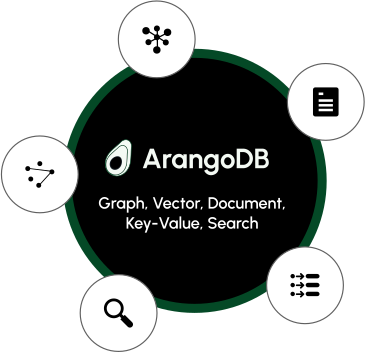
Every data model your applications need, in one engine with one query layer. Query data in natural language, with no stack to stitch together.
Strong Performer — The ForresterWave™: Multimodel Data Platforms, Q2 2026. Download the Report →
Why teams build on ArangoDB
ArangoDB replaces a sprawling stack of point solutions with a single, governed foundation. That consolidation is where the value comes from.
Simplified architecture
One engine for graph, vector, document, key-value, and search lives natively in one contextual data layer, not bolted together after the fact. No separate vector store, graph layer, or search cluster to integrate. Fewer moving parts, fewer failure points.
Reduced operational maintenance
No sync pipelines to drift, one system to secure and monitor. The Kubernetes Operator automates provisioning, zero-downtime upgrades, scaling, and self-healing failover.
Lower total cost
Consolidating five data models into one platform cuts licensing, infrastructure, and the engineering overhead of stitching systems together.
Faster time to value
Query connected data in natural language via AQLizer, with no new query language to learn, backed by AI-assisted tooling that delivers a reported 3–10x developer productivity gain. Prototype to production with no re-platforming.
Trusted and governed
RBAC, encryption in transit and at rest, provenance and lineage, and consistent policy across all models, including HIPAA-compliant deployments.
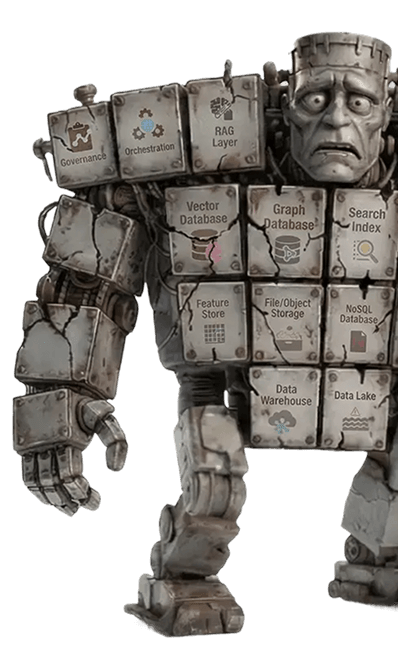
Stop building Frankenstacks
Most enterprise data architectures are stitched together from separate parts: a vector store here, a graph database there, a search index somewhere else, and orchestration glue holding it together. Data gets copied across systems, governance fragments, lineage breaks, and every new initiative rebuilds the same foundation from scratch.
ArangoDB removes that fragmentation at the source.
Graph traversal, vector embeddings, documents, key-value, and full-text search live together in one transactional engine and one natural query. The same object is a document, a graph node, a vector, and a searchable record at once, with no duplicate identity logic and no external sync.
Versus Graph-only database (like Neo4j)
Separate vector store. A sync layer to keep it consistent. Two query languages on every request.
Stop building Frankenstacks.
Start building on a foundation that has it all built in, not bolted on.
Built for enterprise scale
Proven in production, not just benchmarks: ArangoDB is engineered for the largest, most connected workloads.
Distributed sharding
SmartGraphs use value-based sharding to co-locate connected data on the same machine, minimizing network hops on deep traversals. SatelliteCollections replicate reference data to every node for local joins.
Horizontal scaling
A two-tier design scales compute (Coordinators) and storage (DBServers) independently. OneShard optimizes join-heavy and graph workloads, and all models share one partitioning scheme.
High availability
Synchronous replication, automatic failover to in-sync replicas, and Raft-based coordination keep workloads online through scaling and maintenance, with consistent, cluster-wide hot backups.
Translytical workloads
Online Transaction Processing (OLTP) and analytics run on the same data in the same engine: point lookups, traversals, joins, and Best Matching 25/ Term Frequency–Inverse Document Frequency (BM25/TF-IDF) scoring in a single ArangoDB Query Language (AQL) statement, or natural language query.
Time travel and temporal graph traversals
Model “what was true when” today with proven temporal graph patterns. Native Temporal Context to track historical state over time is on the platform roadmap.
Provenance and trust
Every entity and passage carries lineage back to its source, enforced by Role Based Access Control (RBAC) and logged end to end. Agents cite where an answer came from allowing auditors and regulators to verify it.
Ready for AI/ML workloads
AI/ML services built in: a managed GraphML service (GraphSAGE) for node classification, embeddings, and link prediction, plus an in-engine analytics engine (PageRank, centrality, community detection) with results written back to your graph.
Deploy anywhere, with full feature parity
The same Kubernetes Operator and binaries power every deployment mode, so you are never locked into one environment or forced to trade features for control.
Fully managed (SaaS)
Arango Managed Platform (AMP) delivers a consumption-based, multi-cloud service on AWS and Google Cloud.
On-premises
Run in your own data center with full access to the platform, self-managed.
Air-gapped
Run in fully isolated, self-contained environments, built for regulated and mission-critical workloads.
Hybrid and edge
Operate as the central data layer with edge integration via connectors such as Kafka, and cross-topology replication between environments.
From Database to Contextual Data Platform
ArangoDB is the data foundation of the Arango Contextual Data Platform. When you’re ready to build AI applications and agents, you can add capabilities that construct, retrieve, and deliver business context on the same foundation, without moving data between systems or re-platforming.
Available with the Arango Contextual Data Platform:
AutoGraph
Automatically transforms enterprise data into a connected knowledge graph at ingestion, deciding the optimal structure for each domain (full graph vs. vector) so data is retrieval-ready by design.
Arango AutoRAG
Chooses graph traversal, vector search, or both — per question, automatically. Less noise, fewer tokens, answers grounded in what actually fits. Retrieval picks itself.
Deep Search
is Arango’s query-time intelligence: it understands the intent behind a question, decomposes it into subqueries, applies the right retriever to each, and aggregates the results into a single governed answer.
Together they create a Contextual Data Layer, a continuously maintained representation of business context, shared across applications, agents, and workflows, that compounds in value instead of being rebuilt for every initiative.
Trusted by teams solving hard problems
Organizations including Zscaler, NVIDIA, HPE, London Stock Exchange Group, Siemens, PSI, the U.S. Air Force, and the National Institutes of Health build on Arango. Their use cases differ widely, but they share one goal: a trusted foundation they can reuse across applications, teams, and projects instead of rebuilding it for each one.
















Build on the foundation, not another point solution
Start with the multimodel database and grow into the full Contextual Data Platform on the same foundation, with no re-platforming.