
Chapter 2
Where Enterprise AI Breaks Down (And Why)
Co-pilots that work in demos but fail in production. Retrieval that drifts. Costs that spiral. Here’s the pattern — and why it isn’t a model problem.
The AI Failure Zone: Where Most Organizations Get Stuck
Every leader driving AI feels the same frustration: you’re shipping pilots, but nothing truly scales beyond proof of concept.
Co-pilots work in demos but fail in production. Retrieval drifts. Pipelines break. Different teams get different answers to the same question. Governance fragments across tools. Costs increase faster than value. The root cause is a lack of unified, current, and trusted business context that is ready for AI reasoning — the underlying data architecture makes scale brittle, inconsistent, and expensive.
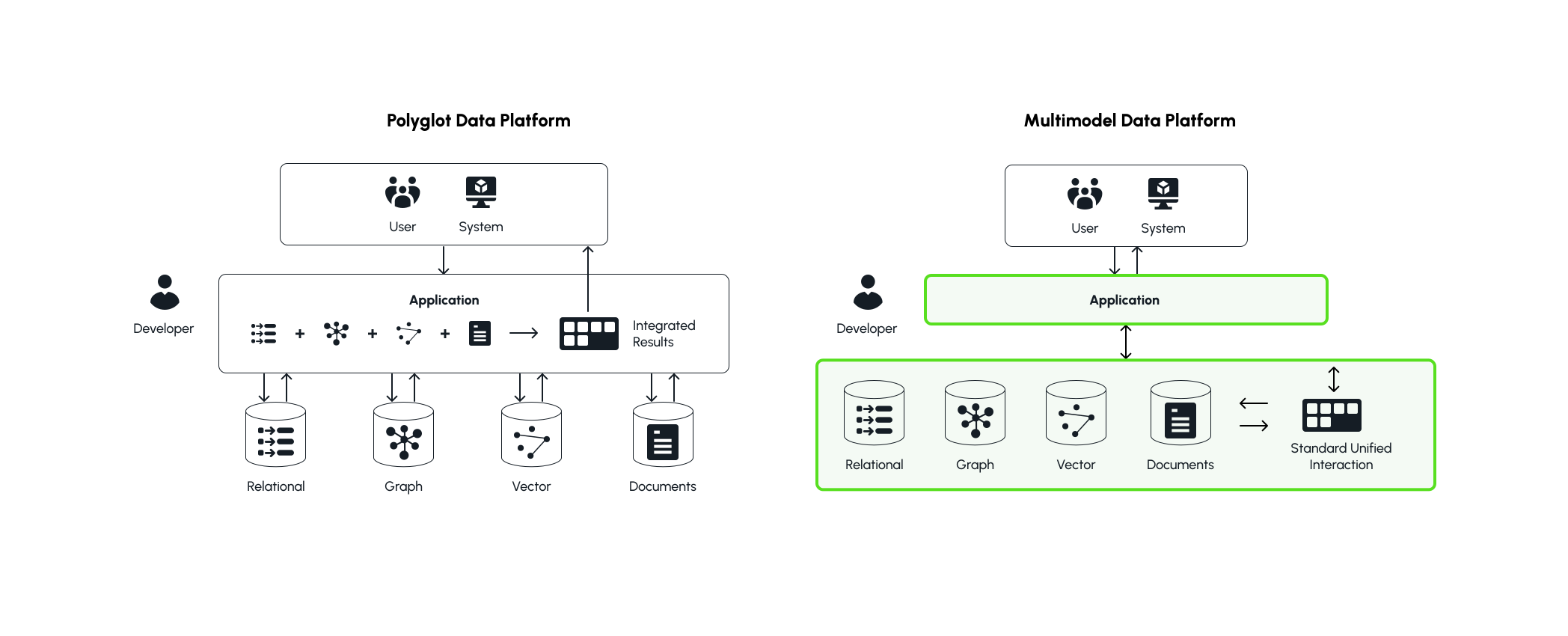
Most enterprises are trying to build Enterprise AI on a fragmented AI data infrastructure that was never designed for reasoning or multimodal context retrieval. Separate vector databases, graph databases, document stores, key value stores, and search engines — plus one-off pipelines — scatter the business context AI needs to deliver accurate, explainable outcomes.
This is the AI Failure Zone: the place where ambition collides with fragmentation, where trust breaks down, where momentum dies, and where most organizations remain stuck today.
This is why most organizations are not seeing a meaningful return on their Enterprise AI investments. Without business context, AI cannot deliver the accuracy, consistency, or explainability the business expects.
The Outcome
Without a shared contextual data foundation, Enterprise AI stalls. It gets trapped between promising pilots and production systems the business can’t trust.
The Root Cause: Why Enterprise AI Breaks Without Business Context
Enterprise AI doesn’t fail because of the models. It fails because the underlying architecture lacks unified business context. The symptoms are visible in production; the cause lives deeper in the architecture. Without it, AI can’t reason, decide, act, or earn trust.
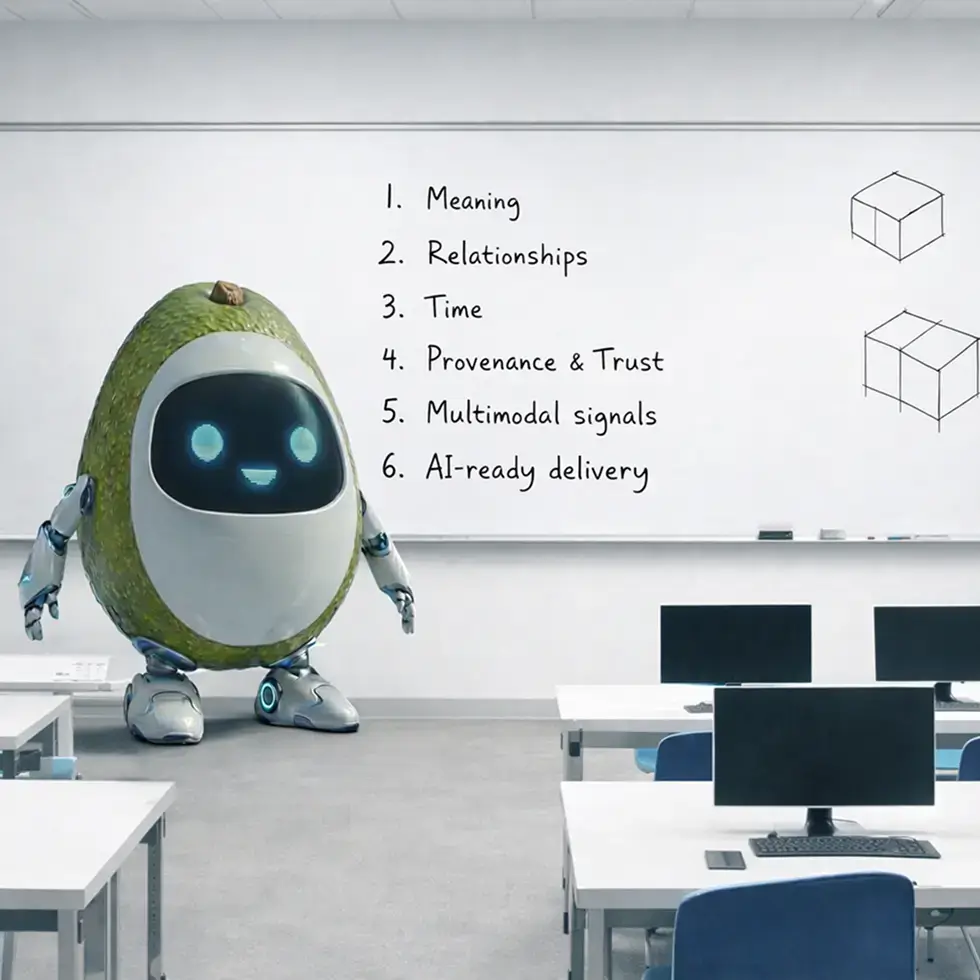
AI today must understand:
- Meaning: shared semantics and definitions across teams
- Relationships: how customers, products, incidents, policies, and systems connect
- Time: what was true when; changes and current state
- Provenance & trust: where information came from and how it changed
- Multimodal signals: text, code, logs, and media connected to the same context
- AI-ready delivery: retrieval, ranking, and citation services that make context usable by co-pilots and agents
This is the difference between a one-off RAG pipeline and a reusable contextual data layer that multiple agents can call consistently.
Meeting these requirements consistently isn’t possible on fragmented data systems — it requires a single data foundation designed to support meaning, relationships, time, provenance, and AI-ready delivery as one. But in most enterprises, these elements live in different systems with different meanings.
When context is fragmented, AI breaks:
- Incomplete retrieval → hallucinations and inconsistent answers
- Context drift → models losing alignment with truth
- Pipeline fragility → failures whenever schemas, data, or models change
- Exploding costs → teams rebuilding business context for every new use case
Analyst research on multi-model data platforms highlights a consistent requirement for agentic and retrieval-heavy AI: a unified Contextual Data Layer that supports key value, search, and multimodal workloads — without stitching systems together.
The Outcome
AI cannot outperform the data beneath it.

The Frankenstack: How Fragmentation Happens
Nobody sets out to build a Frankenstack. It emerges from a series of understandable decisions — made under pressure, in silos, and without an AI-ready data architecture blueprint.
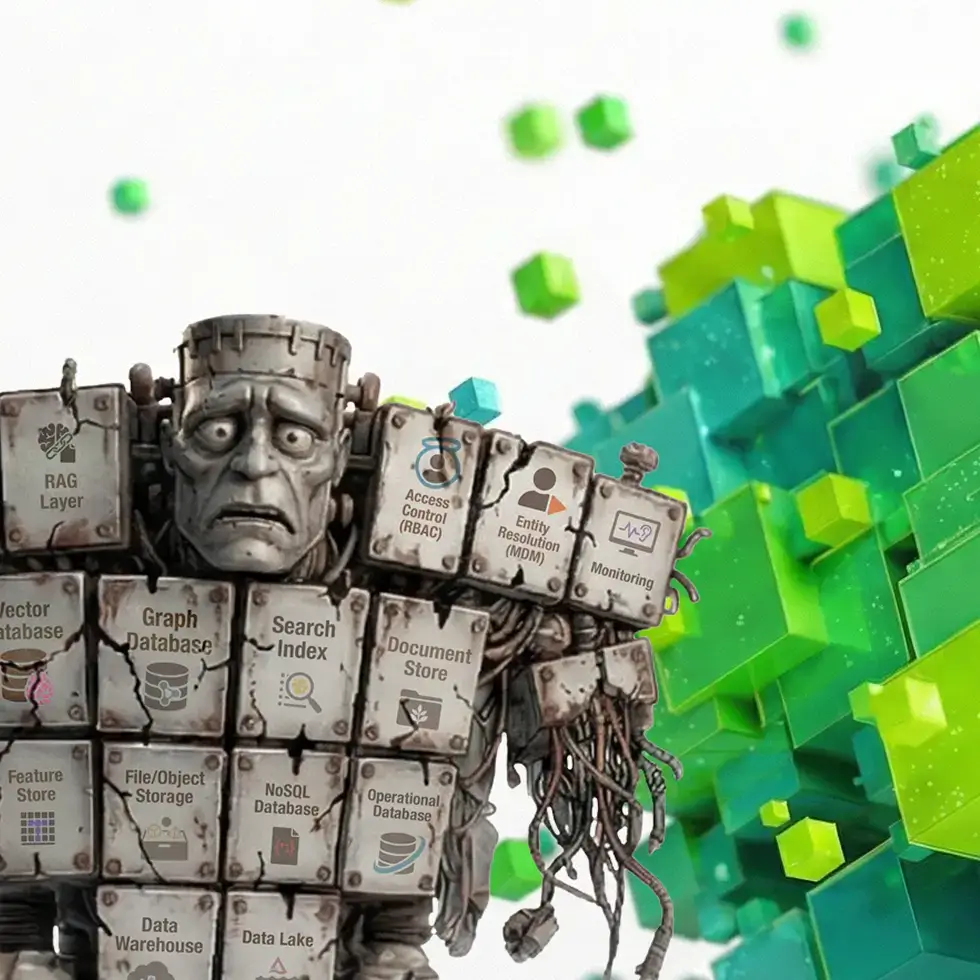
A vector database for one use case. A graph database for another. A document store for content. Key value for entities and state. A search engine for logs and events. A dozen RAG pipelines stitched together. Each solved a local problem. Together, they created global fragmentation.
This is the heart of Frankenstack Fragmentation: a patchwork of separate vector databases, graph databases, document stores, key-value stores, and search engines — plus disconnected pipelines for embeddings, RAG/GraphRAG/HybridRAG, agents, multimodal ingestion, GPUs, and LLM integrations.
Underneath this sprawl is the Five Factor Problem: organizations are forced to adopt, operate, and reconcile five different data engines — graph, vector, document, key-value, and search — just to preserve the business context AI depends on. Even in the best case, this creates hundreds of architectural combinations, each with its own contracts, integrations, SLAs, scaling patterns, drift risks, and failure modes.
The consequences are predictable:
- Context scattered across systems
- Retrieval inconsistencies and contradictory answers
- Pipeline fragility as schemas, models, and data shift
- Redundant semantics and duplicated metadata
- Rising cost per use case as complexity compounds
This isn’t technical debt, it’s context debt. And context debt kills AI scale.
“Traditional data architectures weren’t built for this moment. Agentic AI demands unified context.“
— Indranil Bandyopadhyay, Principal Analyst, Forrester
The Outcome
What starts as flexibility becomes a long-term constraint. Data fragmentation turns context into debt that compounds with every new AI use case.