
Chapter 1
Why Enterprise AI Is a Competitive Mandate
Enterprise AI advantage compounds quickly. Here’s why the gap between leaders and laggards is opening now — and what’s already measurable for the companies ahead of it.

The Enterprise AI Pressure Zone: Why The Race Is Already On
Across industries, something unprecedented is happening. Enterprise AI has become a competitive mandate. Unlike previous technology cycles, AI advantage compounds quickly — small early leads in data and context translate into lasting competitive separation.
Executives, boards, teams, and customers all feel it. Every CEO is asking, “Where are our co-pilots? Where are our agents? How are we using Enterprise AI to win?” Every board is asking: “How does Enterprise AI improve revenue, reduce cost, strengthen compliance, and accelerate innovation?”
And competitors are already pulling ahead with context-aware AI — AI that can reliably retrieve and reason over shared, connected, trustworthy enterprise knowledge, not just isolated documents. Investors are already seeing the impact in the numbers. According to PwC’s 2025 Global Investor Survey, investors report AI-driven improvements in productivity (86%), profitability (71%), and revenue gains (66%) in the companies they invest in.
The pattern behind these gains is consistent: Enterprise AI succeeds only when it’s grounded in unified, current, and trusted business context. A Contextual Data Layer provides the foundation that makes this context usable and reusable across co-pilots and agents. In practice, this advantage shows up in a few repeatable ways.
The Outcome
Competitive advantage increasingly belongs to organizations that establish shared business context early — before fragmented data architectures turn speed into long-term drag.
Enterprise AI-powered advantages emerging today:
- Faster issue resolution with AI agents that understand the business context across tickets, docs, logs, policies, and runbooks before recommending actions to humans
- Smarter decisions via natural-language insights backed by traceable sources and relationships
- More trustworthy answers using ContextRAG (GraphRAG, VectorRAG, HybridRAG) and hybrid retrieval over connected enterprise knowledge
- Stronger security and compliance through centralized access controls, auditability, and contextual anomaly detection
These capabilities are already reshaping how leading teams work. Companies operating with a Contextual Data Layer are resolving issues faster, operating with greater clarity, launching AI features at unprecedented speed, and making decisions the organization can trust.
The gap between leaders and laggards is widening fast.
Enterprise AI Use Cases
Organizations across industries are already creating separation — not because they hired more AI engineers or bought more models, but because they invested in a Contextual Data Layer that makes context reusable across use cases.
In practice, this advantage shows up in a set of repeatable patterns, starting with the most universally applicable. These use cases span both technical and business functions, but they all rely on the same trusted AI data foundation: unified, current, and trusted business context — explainable, up-to-date, and ready for AI to reason, decide, and act.

Support Co-Pilots
Organizations with millions of documents, tickets, logs, runbooks, SOPs, and playbooks can resolve issues 20% faster. Support agents act as always-on digital experts, unifying enterprise knowledge and operational context to triage incidents, cite the right evidence, and recommend step-by-step resolution paths — including guided runbook execution and, when approved, handoffs to workflow automation.
Who benefits most?
- Large enterprises with high ticket volume (support, HR, IT)
- SaaS and product companies with complex troubleshooting workflows
- Global organizations with distributed teams needing consistent and explainable outcomes
What changed?
- Multi-model and multimodal contextual data layer (graph, vector, document, key value, search) across tickets, logs, and documentation
- Connected context (entities, relationships, and temporal state) to improve precision and explainability
- Reusable retrieval services that multiple teams can share, instead of rebuilding pipelines per use case
Outcomes
- Reduced escalations and Mean-Time-to-Resolution (MTTR)
- More consistent, explainable answers
- A trusted AI agent used across Support, Sales, HR, and Finance
Real-Time Video Intelligence
Organizations that once spent hours reviewing video streams are now getting instant answers powered by a Contextual Data Layer.
Who benefits most?
- Retailers with loss prevention and store operations workflows
- Airports and transportation hubs
- Manufacturing floors requiring real-time safety and process intelligence
What changed?
- Multi-model and multimodal context layer (graph, vector, document, key value, search)
- Reasoning across time, locations, and camera streams using connected metadata and retrieval
- Event and metadata extraction (objects, timestamps, locations) connected to enterprise context for retrieval and reasoning
Outcomes
- Accurate, explainable, real-time insights across streams
- Safer, more efficient operations
- A scalable foundation for enterprise-grade video intelligence

Engineering Intelligence & Issue Resolution at Scale
Teams managing millions of logs, bug reports, and diagnostics are finally correlating issues across products and teams, instantly.
Who benefits most?
- SaaS, enterprise software, and platform teams
- Hardware companies with massive diagnostic data
- Engineering organizations running multi-service architectures
What changed?
- Multi-model and multimodal contextual data layer (graph, vector, document, key value, search)
- Graph-powered correlations at massive scale
- Automated triage and prioritization
Outcomes
- Faster, more reliable engineering decisions
- Improved product quality and development velocity
- Real-time intelligence instead of manual investigation
Trusted Enterprise AI for Regulated Industries
Organizations operating under strict compliance requirements are moving Enterprise AI pilots to production faster — with full explainability.
Who benefits most?
- Financial services, insurance, and payments
- Healthcare providers and life sciences
- Government, public sector, and defense agencies
What changed?
- Multi-model and multimodal contextual data layer (graph, vector, document, key value, search)
- Built-in lineage and provenance, with policy controls where needed
- Simplified architecture replacing brittle pipelines
Outcomes
- Faster deployment of trusted AI apps
- Reduced cost and complexity
- A scalable, compliant-by-design foundation

Real-Time Insights for Retailers, Suppliers & Consumers
Platforms once stuck with stale BI dashboards now deliver real-time pricing, promotion, and assortment insights.
Who benefits most?
- Retailers, Consumer Packaged Goods (CPG), and supply chain platforms
- E-commerce marketplaces
- Merchandising, pricing, and operations teams
What changed?
- Multi-model and multimodal contextual data layer (graph, vector, document, key value, search)
- Natural-language retrieval that can be materially faster in early implementations by reducing cross-system joins and brittle pipelines
- Hybrid search powering supplier and retailer intelligence
Outcomes
- Live insights that drive margin and customer experience
- Personalized consumer experiences
- A platform that leapfrogs competitors with lower Total Cost of Ownership (TCO)
Across these use cases, the pattern is consistent: when business context is current and trusted, Enterprise AI delivers faster results, stronger economics, and greater trust at scale.

Enterprise AI Outcomes in Practice
When organizations break free from fragmented IT systems, siloed data, and disconnected operational tools and build on a Contextual Data Layer that provides unified, current, and trusted context, the impact is immediate and measurable.
Revenue & Margin Outperformance
Organizations that operationalize AI on strong data foundations outperform peers on growth and profitability.
- 66% of investors report AI-driven revenue gains in the companies they follow (PwC).
- AI leaders achieve approximately 1.7× higher revenue growth and 1.6× higher EBIT margins compared to laggards — driven by scalable foundations rather than isolated pilots.
Context-aware co-pilots enable more relevant engagement across sales and service, accelerating decision-making and improving conversion quality.
Lower Cost of Operations Through Consolidation and Reuse
AI impact increasingly shows up in cost structure, not just experimentation.
- 71% of investors report profitability improvements from AI adoption (PwC).
- Automation across systems reduces manual handoffs and reconciliation.
- Consolidating fragmented pipelines helps control infrastructure sprawl and rising AI operating costs.
Gartner consistently points to poor data quality, integration complexity, and cost overruns as leading causes of GenAI project failure beyond proof of concept.
Measurable Productivity Gains Across the Enterprise
AI value is increasingly realized through time saved and faster execution — not headcount reduction.
- 86% of investors report AI-driven productivity improvements (PwC).
- Knowledge workers spend less time searching, validating, and reconciling information when AI is grounded in shared, connected, and trustworthy business context.
- AI agents and co-pilots support engineering, product, HR, finance, and operations with consistent, explainable answers embedded directly in daily workflows.
McKinsey notes productivity gains depend on redeploying saved time effectively — something only possible when AI outputs are trusted, explainable, and operationally integrated.
Reduced Risk & Stronger Governance
Risk and governance failures remain a primary barrier to scale.
- Gartner predicts 30% or more of GenAI projects will be abandoned post-PoC by end of 2025 due to data quality and risk control gaps.
- 61% of U.S. organizations are already in “strategic or embedded” Responsible AI stages where governance is integrated into operations (PwC).
- 78% of mature organizations rate themselves very effective at Responsible AI priorities, compared to 35% in earlier stages.
Shared context, traceability, and provenance turn trust from an afterthought into a built-in capability.
Faster Innovation Cycles
Reusable business context serving multiple agents accelerates innovation across the enterprise.
- 64% of respondents say AI is already enabling innovation (McKinsey).
- 62% report their organizations are experimenting with AI agents.
- “Future-built” companies see up to 5× revenue increases and 3× cost reductions from AI versus others (BCG), powered by scalable foundations rather than one-off pilots.
The Outcome
Across industries and functions, reusable business context turns isolated AI wins into scalable, enterprise-wide capabilities.

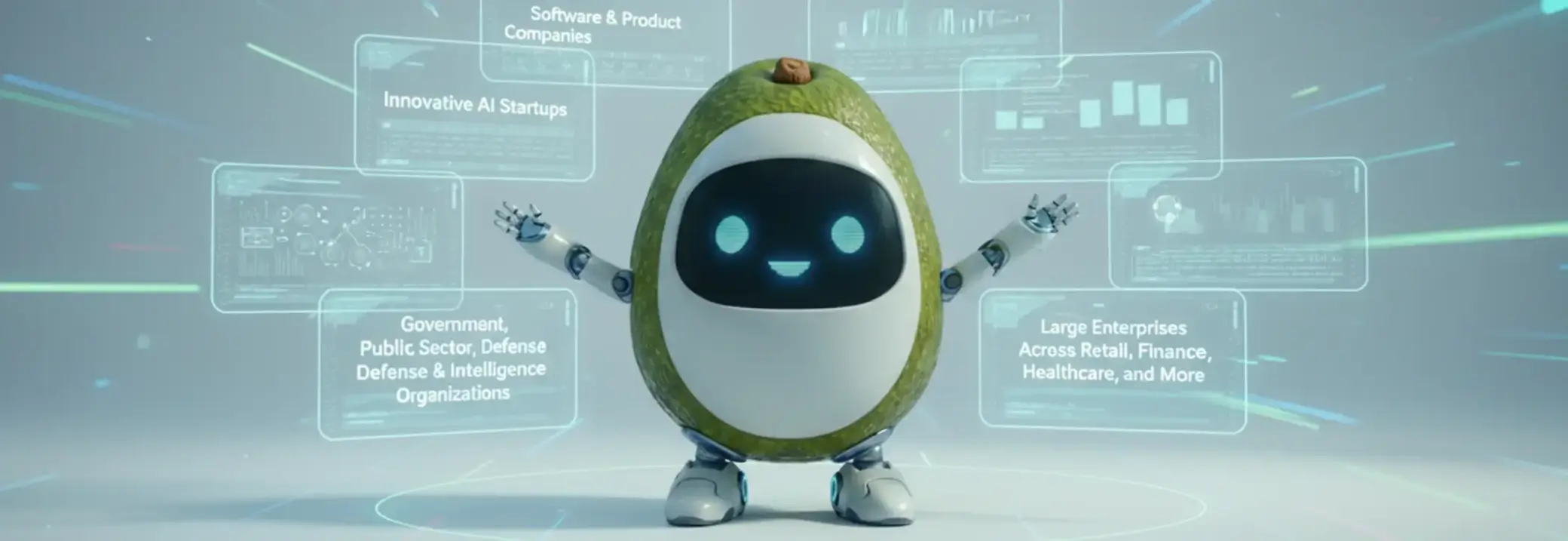
How These Outcomes Show Up Across Different Organizations
The outcomes are consistent — but how they manifest varies by organization.
Software & Product Companies
Faster iteration cycles, tighter customer feedback loops, and AI co-pilots that accelerate engineering, product, and support without rebuilding context for each feature.
Government, Public Sector, and Regulated Organizations
Simplified case resolution, clearer decision-making, and increased trust as AI operates on traceable, explainable, and current information.
Innovative AI
Startups
Higher velocity from day one, embedding intelligence without inheriting the fragmented patterns that slow larger organizations later.
Large Enterprises Across Industries
Reduced silos, more personalized customer experiences, lower operational risk, and teams operating from the same shared understanding of the business.