
Chapter 3
What a Contextual Data Layer Actually Is
A Contextual Data Layer is the bridge between fragmented enterprise data and reliable AI. Here’s what it is, what it replaces, and what changes for the people building on top of it.
The Missing Layer: What a Contextual Data Layer Is (and Isn’t)
A Contextual Data Layer (CDL) gives Enterprise AI shared meaning, connected relationships, and trusted, up-to-date business context — so co-pilots, chatbots, and agents can retrieve and reason with consistency and confidence.
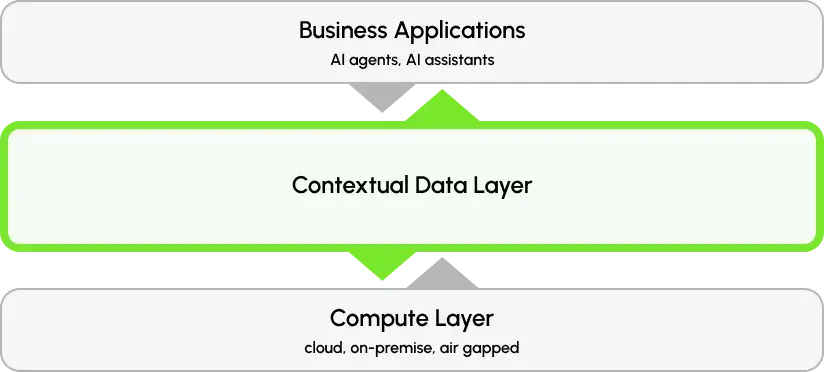
Think of the Contextual Data Layer as the bridge between enterprise data systems and LLMs. It sits above fragmented sources — such as warehouses, lakes, ticketing systems, documents, and logs — and below co-pilots and agents. It provides shared semantics, connected context, and provenance that make AI reliable at enterprise scale.
A Contextual Data Layer:
- Establishes shared meaning, ensuring consistent definitions across systems and teams
- Connects entities through relationships, so AI can reason across customers, products, policies, and operations
- Preserves provenance and lineage, enabling explainable answers and confidence in results
- Maintains temporal context, capturing what changed, when, and how it impacts decisions
- Supports multimodal enterprise data, spanning structured records, documents, logs, code, and media within the same contextual foundation
- Delivers AI-ready retrieval and reasoning, enabling context to be reused across co-pilots and agents at scale
When this foundation is in place, AI stops behaving like a best-guess engine and starts behaving like a true collaborator:
- Teams move faster — and with confidence.
- Agents, co-pilots, and chatbots become trustworthy.
- Retrieval becomes more accurate, complete, and explainable.
The Outcome
A Contextual Data Layer becomes the foundation of an AI-powered business — driving better outcomes, operational trust in production, and continuous innovation.
The Architecture Shift: From Pilots to Enterprise
Most organizations don’t fail at Enterprise AI because they lack ideas. They fail because the architecture that supports early pilots cannot scale to production.
AI pilots are typically built fast and locally: a single use case, a narrow dataset, a bespoke retrieval pipeline, and a specific model. This works in demos. It breaks down as soon as organizations try to reuse, extend, or operationalize AI across teams.
As Enterprise AI matures, the architectural requirements change fundamentally:
- from single use cases to many
- from isolated datasets to business context
- from experimental pipelines to production systems
- from model-centric thinking to context-centric design
What worked for a pilot becomes a liability at scale. Each new co-pilot or agent requires rebuilding context, re-integrating data, and re-establishing trust. Over time, pilots accumulate into fragile systems that are hard to evolve.
The shift to Enterprise AI requires a different data foundation — one where business context is no longer rebuilt for every application, but standardized, shared, and reused across the organization. This is the architectural transition that separates experimentation from transformation.

The Outcome
Enterprise AI scales when architecture shifts from project-by-project pipelines to a contextual data layer that every AI application can rely on.

What High-Performing Enterprises Do Differently
- Invest in a Contextual Data Layer that makes unified, current, trusted business context reusable across teams and use cases
- Standardize meaning, relationships, provenance, and time as first-class requirements for Enterprise AI
- Build AI-ready contextual data layers, then reuse them across co-pilots, agents, and applications
- Consolidate fragmented data systems to reduce fragility, duplication, and operating costs
- Redirect spend from pipeline maintenance to productized AI capabilities that ship and scale
- Align executives and platform teams on an AI-ready data architecture blueprint for Enterprise AI

The Outcome
High-performing organizations treat business context as a product — built once, reused everywhere, and continuously improved as the business evolves.
The Leadership Imperative: Impact on AI Leaders & Builders
Behind every AI transformation are the people carrying the weight of it — CTOs, CIOs, CDOs, CPOs, Heads of AI, platform and enterprise architects, engineering and AI/ML leaders, and innovation leaders.
In a fragmented AI data infrastructure, their day-to-day reality is harder than most realize:
- CTOs unblock teams instead of driving strategy
- Product teams can’t ship reliable AI features
- Platform and architecture leaders spend their time stitching systems together instead of designing for scale
- Innovation leaders prototype fast but can’t scale
A fragmented architecture drains momentum and creativity. A Contextual Data Layer gives leaders their time, confidence, and momentum back. When business context is shared, connected, and trustworthy:
- Roadmaps accelerate
- Retrieval is consistent
- AI features ship weekly
- Teams move from repair to creation
The impact extends beyond technology, reshaping how teams operate and collaborate.

The Outcome
When context is unified, leaders shift from managing fragility to enabling momentum — freeing teams to build, ship, and innovate with confidence.