
Chapter 2
What is a contextual data layer?
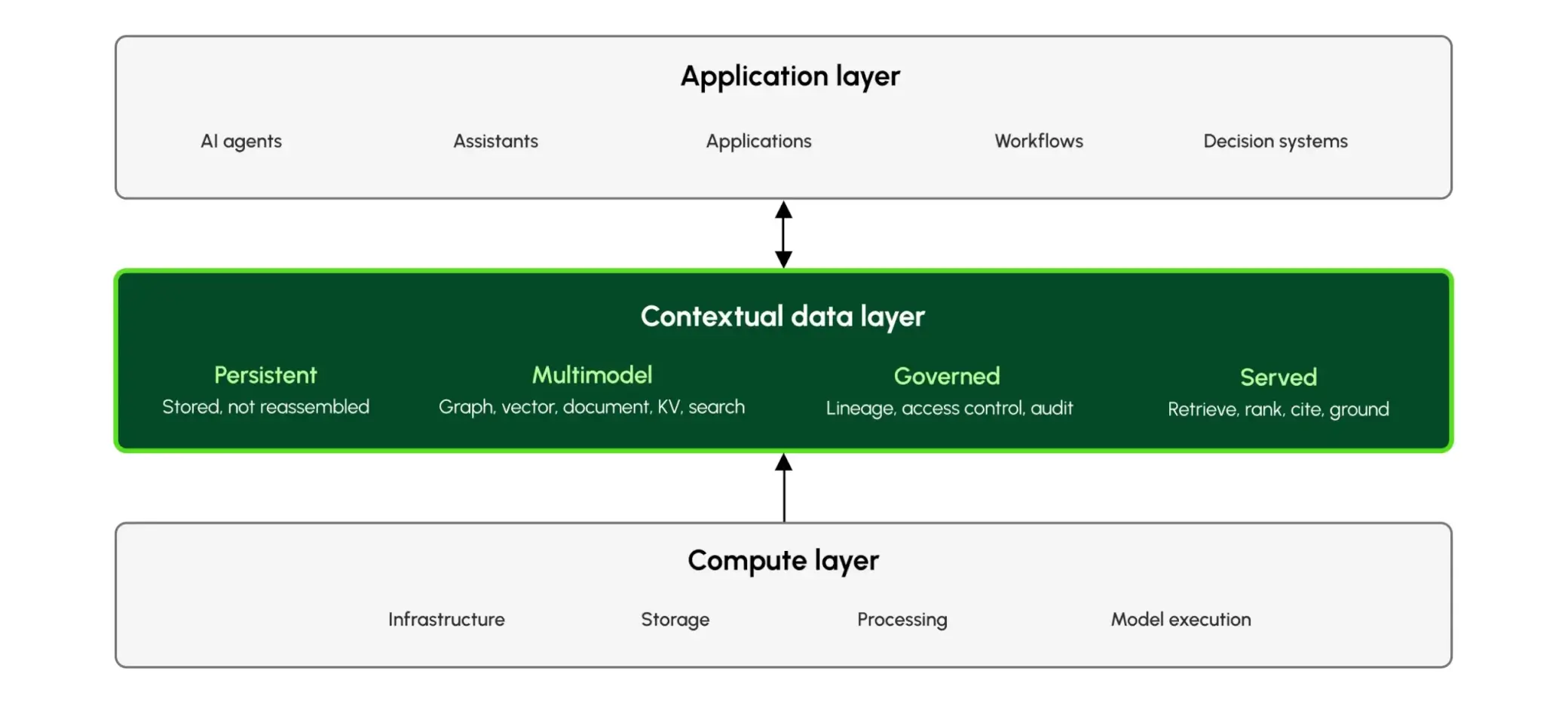
A persistent, multimodel architectural tier that bridges enterprise data and AI systems — giving AI one continuous representation of the business instead of a collection of specialized stores glued together at inference time.
Persistent
Context is stored and maintained, not reassembled per query.
Multimodel
Graph, vector, document, key-value, and search — in one model.
Governed
Lineage, access control, and audit are structural, not bolted on.
Served
Retrieve, rank, cite, and ground are context layer primitives.
How it works
The layer operates as the system of record and control plane for enterprise context. Data flows in from every source that matters — operational systems, documents, events, unstructured content — and is contextualized once. AI agents and applications operate against this governed layer rather than querying underlying sources directly.
Consider a support operations use case: a document store holds tickets and Knowledge Base articles; a graph models the relationships between customers to products and incidents; vectors capture semantic similarity; key-value tracks current operational state. Inside a contextual data layer, these are not isolated systems — they are one continuously maintained model.
The limitation of current architectures
From Frankenstack to trusted data foundation
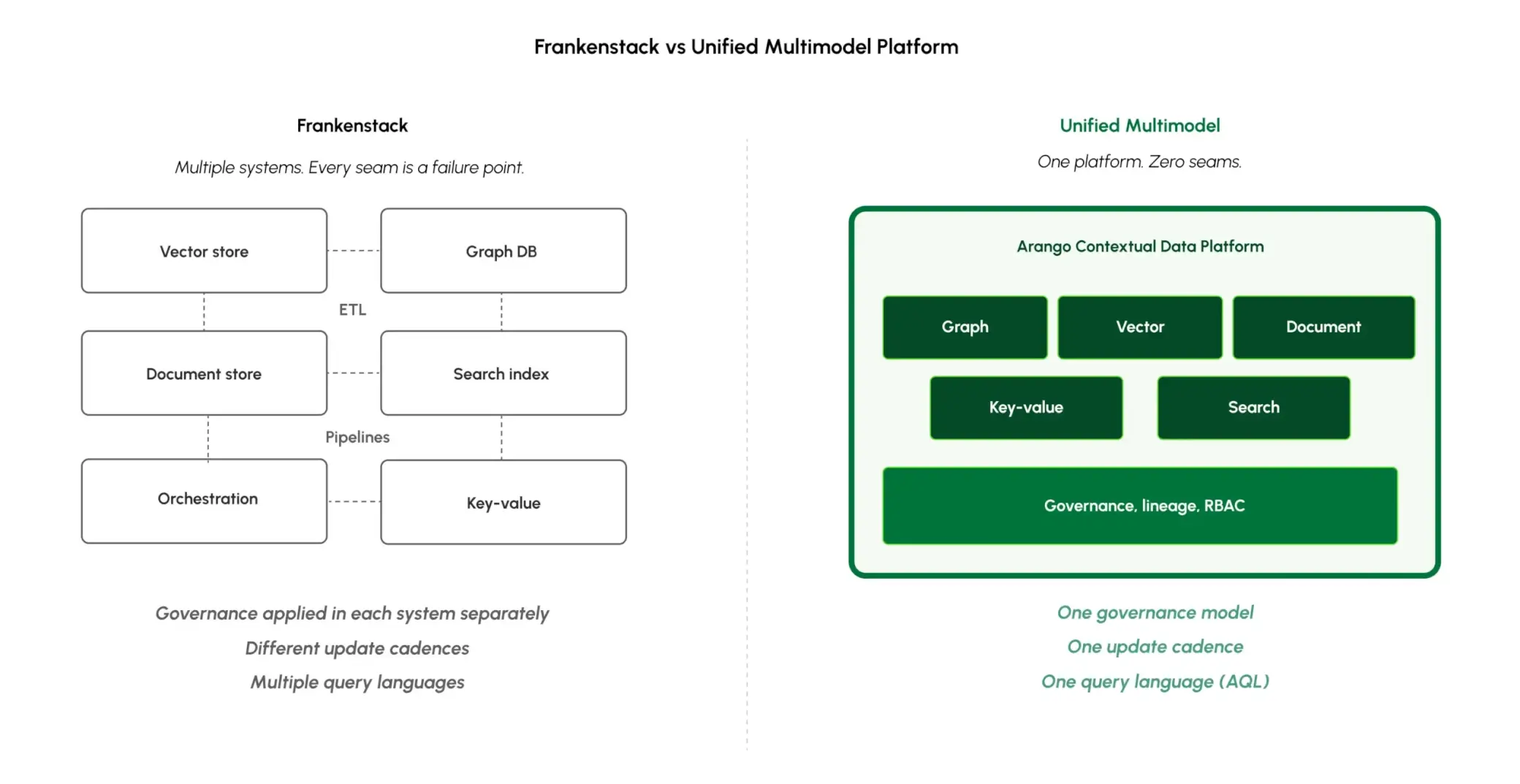
In many enterprise AI implementations, context is not persisted. It is reconstructed at inference time by stitching together semantic similarities, relationships, structured records, and keyword matches — each pulled from a separate system. Each piece was the right call when it was added, but together, they become the problem.
“You can’t scale what you can’t govern, and you can’t govern what you can’t structure.”
— Bain, Governance, Trust, and the Data Foundation
From reconstruction to persistence
A contextual data layer inverts the usual model. Instead of reconstructing context at query time, context is persisted once and served many times.
A customer
is a document
Their link to a contract
is a graph edge
Similarity to a past ticket
is a vector
All of it
in one model
Remember: A contextual data layer persists context once. From that single decision, everything else improves — response speed, consistency, and explainability.