
Chapter 1
Why agentic AI breaks traditional architectures
Agentic AI is redefining enterprise software. The model in front is no longer just a chatbot waiting for a question; it is a system that perceives, reasons, and acts across multiple steps and systems.
Why agentic AI changes the architecture
Agentic systems adapt to dynamic environments. As AWS describes them, they continuously perceive their environment and respond to change. Traditional SaaS architectures were built for the opposite problem: repeatable workflows against standardized schemas.
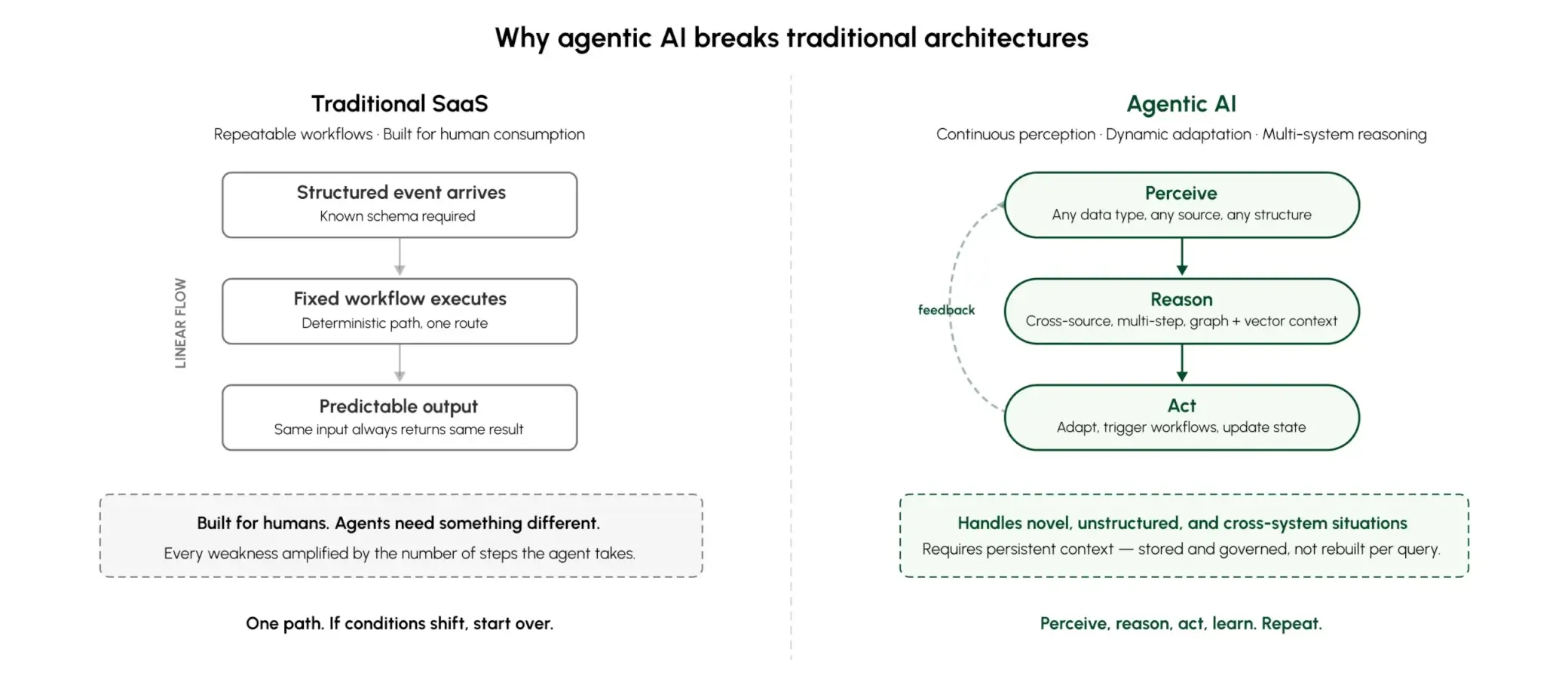
Six architectural requirements separate production-ready agentic AI from prototypes that stall after the demo:
Every weakness in your data architecture gets amplified by the number of steps the agent takes.

Six failure modes in production AI
What goes wrong when context is missing
01
Inconsistent results across queries
The same question returns different answers because the underlying context isn’t unified.
02
High latency in multi-step reasoning
Agents correlating across systems pay a round-trip tax at every step.
03
Duplicated data and indexing pipelines
The same data transformed and stored once for search, once for graph, once for embeddings.
04
Governance inconsistencies
Data accessible in one system but restricted in another — enforced nowhere consistently.
05
Operational fragility
When an ingestion job or embedding pipeline fails, the system serves stale or partial context without signaling it.
06
Costs that compound at inference time
Reassembling context at query time means over-fetching. Larger context windows, more tokens per query, and costs that multiply invisibly across every agent and workflow.
What is context?
Context is the working knowledge of your business: the entities, relationships, history, rules, and meaning that explain what is happening and why. Data is rows and records; context is what those rows mean, how they connect, and what is true about them right now. Persisted as a unified model, not reassembled on demand.
Definition
A contextual data layer is a persistent, structured representation of business reality. It combines meaning, relationships, state, and time in one model that AI systems can query directly
- Multimodel by nature — entities in documents, relationships in a graph, meaning in vectors, state in key-value, text in search indexes.
- Persistent and live — a maintained layer, not reassembled at inference time per query.
- Queryable as a whole — not federated across systems or stitched by application code.
- Governed — provenance and policy travel with the data, not bolted on after.

AI without context is a liability. With context, it becomes leverage.