
Chapter 4
Case studies
Case study 01 · SaaS support
AI-powered service & support
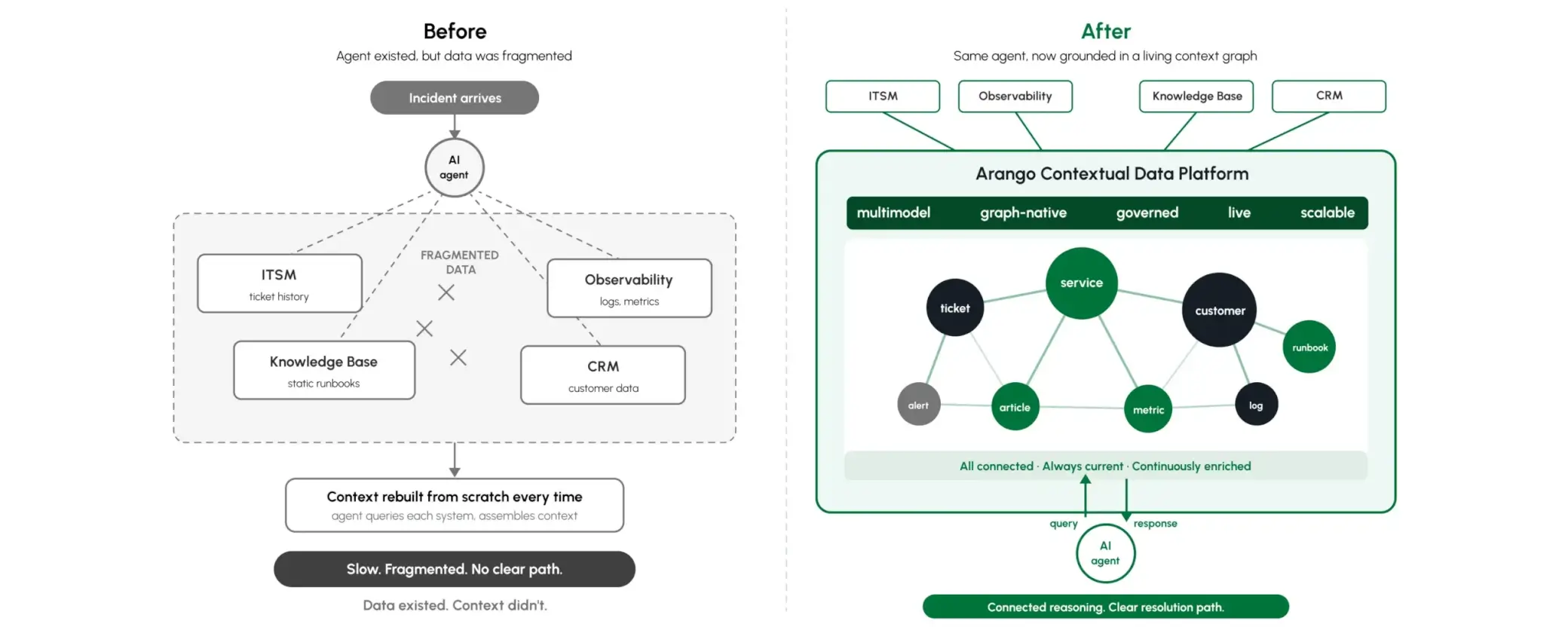
A global SaaS provider managing 30,000+ tickets per day across Tier 1 through Tier 4 was suffering not from a lack of data but from fragmentation. Support agents navigated across disconnected systems — ITSM, observability, knowledge base, CRM — and manually reconstructed context per incident. The organization implemented a contextual data layer on Arango — ingesting all relevant data into a single platform and continuously contextualizing it, creating a living context graph that the AI support agent operated against directly.
Outcomes
72 → 24
hours: Tier 4 MTTR, before and after
30 → 12
minutes: Tier 1 MTTR, before and after
40–60%
reduction in manual triage effort
30K
support tickets per day, now AI-grounded
Case study 02 · AI agent
PSI Clinical Research
PSI is a global clinical research organization. Selecting the right trial sites is one of the most expensive decisions in drug development: trials can take a decade and cost hundreds of millions. The data existed already — detailed records on investigators, institutions, protocols, and historical outcomes — but it was fragmented.
PSI built SYNETIC, an AI-enabled knowledge system powered by the Arango Contextual Data Platform, unifying structured and unstructured records into one continuously maintained context graph.
“Our AI agent doesn’t just recommend trial sites — it explains why, with the data and relationships that led to the recommendation.”
— Andrei Seryi, Director of Knowledge Management and Process Improvement, PSI

Outcomes
6 wks → min
site identification time
100Ks
research projects unified
Millions
per trial saved