Chapter 6
The Arango Contextual Data Platform
How the Arango Contextual Data Platform is architected, what runs in each of the three layers, and how it maps to each of the six requirements.
Arango Contextual Data Platform 4.0 delivers all six architectural requirements in one integrated system. Rather than assembling specialized tools at query time, it persists context in a multimodel substrate and serves it to AI through native, agent-ready interfaces — including 20+ AI services, an MCP server, and natural language interfaces for direct agent interaction.
Build enterprise context once. Reuse it everywhere.
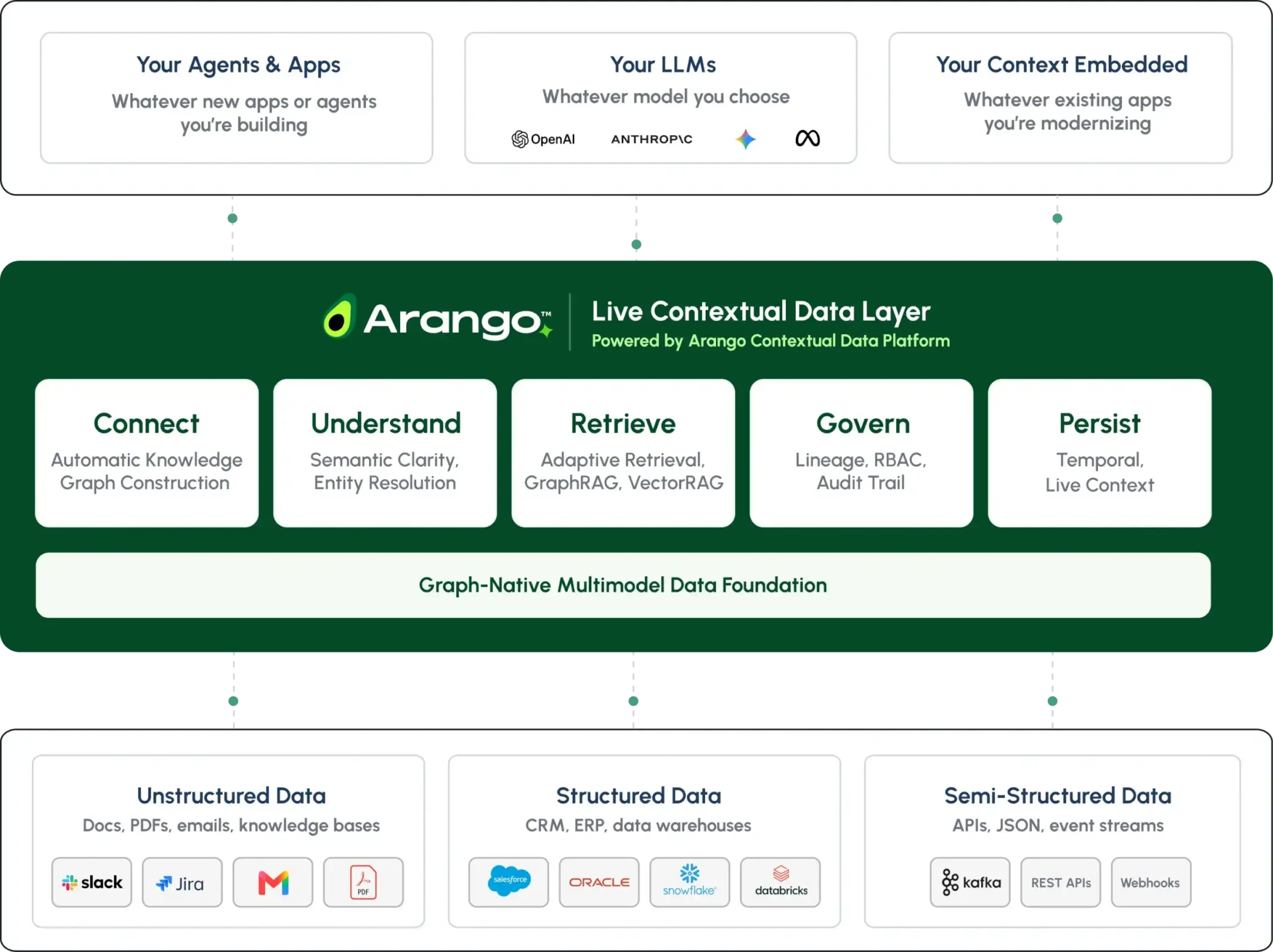
How Arango delivers each contextual data layer requirement
| Semantic clarity | AutoGraph builds domain-aware knowledge graphs. AQL enforces consistent querying across modalities. |
| Relationships | Native graph model. AutoGraph and GraphRAG for relationship-aware retrieval |
| Freshness & time | Temporal modeling within documents and graphs. AQL for time-based filtering. Continuous updates via AutoGraph. |
| Provenance & trust | RBAC, audit logging, and lineage. Query traceability across AQL execution. |
| AI-native service | Deep Search for adaptive retrieval. GraphRAG and HybridRAG for context-rich responses. MCP server and APIs. |
| Multimodel coverage | Graph, document, vector, key-value, and search in one system — AQL spans all five in a single execution path. |
Under the hood
01
AutoGraph
How AutoGraph creates context
Knowledge graphs traditionally take weeks of manual work — defining ontologies, resolving entities, mapping relationships. AutoGraph automates construction directly from enterprise data, maintaining the graph as sources change.
Automated
Continuous
No ontology design
02
AQL
One query, four models
AQL spans graph, document, vector, key-value, and search in one execution path. A single query can traverse a customer graph, filter by document fields, rank by vector similarity, and return grounded results with lineage.
Graph
Vector
Document
Key-value
Search
03
Deep Search
How Deep Search picks the right retrieval strategy
When a question arrives, Deep Search scans relevant topics, breaks the request into targeted subqueries, selects the right retrieval strategy for each based on data type and domain, and aggregates the results into a single unified response — more complete and trustworthy than single-pass retrieval alone.
Subquery Routing
GraphRAG
VectorRAG
Adaptive Aggregation
04
Deployment
How it deploys
Kubernetes orchestration, fine-grained RBAC, Bring Your Own Container (BYOC) for custom models, and cloud, on-prem, hybrid, managed (AMP), and air-gapped deployment modes for regulated environments.
Cloud
On-prem
Hybrid
Air-gapped
Resilience & disaster recovery
3×
Replication
Configurable replication factor ensures data survives node failures.
<10s
Automatic failover
Leader election completes in under 10 seconds; clients retry transparently.
5-min
Point-in-time recovery
Continuous backup with 5-minute RPO; restore to any timestamp.
Live
Health monitoring
Prometheus metrics for query latency, error rates, and replication lag.
0
Schema evolution downtime
Add fields, indices, and edge types without blocking writes.
Before
Separate backup procedures for graph, vector, and document databases
Restoring consistent state required manual coordination
Multi-hour downtime per recovery event
After
Platform snapshots include all models atomically
Point-in-time restore to any 5-minute window
Recovery tested monthly — measured RTO: 12 minutes
Value drivers & benchmark results
30–50%
reduction in integration complexity
2–4×
faster AI development cycles
25–40%
lower architectural overhead
Decision accuracy also improves by 20–35% when AI systems reason over connected, governed context rather than retrieval from fragmented stores.
Remember: Arango delivers all 6 requirements in one platform — automated context modeling, adaptive retrieval, and agent-ready interfaces, on top of a native multimodel substrate.